

Article 4 of 5 in the array-thinking-to-q series.
Provenance. Every q and J snippet below is copied from the curriculum’s J laboratory and transition chapter, plus one REPL transcript from lesson 01.
make verifyruns those lessons on J 9.7.1 and KDB-X CE 5.0 and diffs every output against the lesson pages, and a second check requires every block in this article to be identical to a block on those pages. So no output here was typed by hand. The one exception is that transcript: it shows q failing to parse a line, which no runnable file can contain, so it is quoted from a real session and is one of the two blocks the repo marks as not run.
New to q? It is the language of kdb+, a column-oriented time-series database best known in finance. Article 1 has a one-minute primer on array languages. Beyond that, this article explains each piece of q and J syntax the first time it appears.
Here is a perfectly good q program. It sums a list.
x:1 2 3 4 5;
r:0; i:0;
do[count x; r+:x i; i+:1];
show r
15
Fifteen. Correct. It will still be correct next year, in production.
That is the problem.
The language will not tell you
q has do[]. It has while[]. It has x i for indexed access, r+:… for add-and-reassign, and a
perfectly ordinary notion of a counter you increment yourself. Every reflex you brought from
Python or Java or C has somewhere to land, and the answers come out right. (The idiom, for the
record, is sum x.)
So you can write q for months, shipping and passing tests, and never once make the shift the language was built around. Nothing fails. There is no error and no warning. The loop is right there, and it works.
I want to be precise about the contrast, because the easy version of this argument is wrong. J does not forbid loops either. To show that I need about two minutes of J, so here they are.
2 * 3 + 4      NB. right to left: 3 + 4 first, then 2 * 7
- 5            NB. one argument (monad): negate
10 - 3         NB. two arguments (dyad): subtract
i. 5           NB. monad i.: the first five integers, like q's til
14
_5
7
0 1 2 3 4
J reads right to left with no operator precedence (so does q), and i. 5 counts from zero the
way q’s til 5 does. Most primitives mean one thing with a single argument on the right and
another with arguments on both sides. Negative numbers are
written _5, NB. starts a comment, and =: assigns a name. That is enough to read everything
below.
Now the loop:
sumloop =: 3 : 0
r =. 0
for_i. y do. r =. r + i end.
r
)
sumloop 1 2 3 4 5
15
Same fifteen. J has for_i., while., if. and local assignment: the whole imperative apparatus.
The difference is what it costs you in feel. To write that loop I had to leave J’s ordinary
notation entirely. 3 : 0 opens an explicit definition, =. replaces =:, y is the argument’s
fixed name, i is a loop variable you name (it takes each item in turn), and the block closes with a lone ) on its own line. That
is five lines of visibly foreign machinery, in a language where the alternative is +/. Nothing
stops you. Everything about it says you have wandered off.
The q version says nothing of the kind. do[count x; r+:x i; i+:1] is one line of ordinary q,
indistinguishable in texture from the q around it. It doesn’t look like a detour. It looks like
Tuesday.
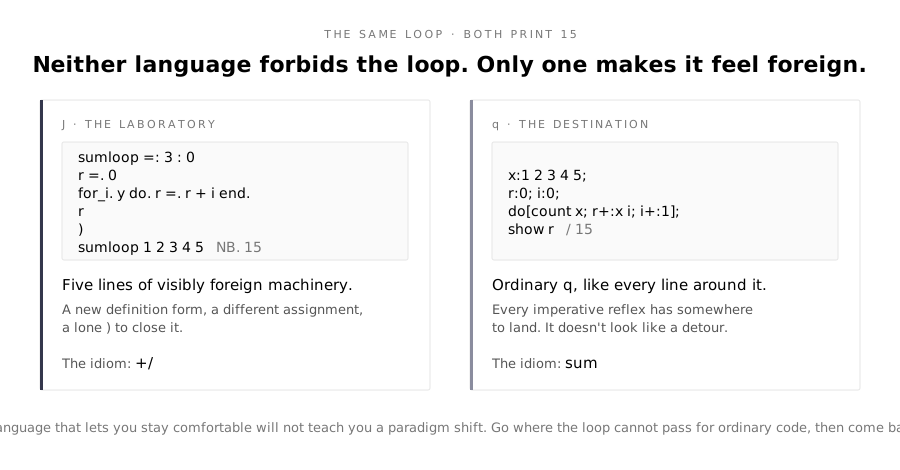
That is the whole case for the laboratory. J is no stricter than q. What it does is make the imperative path feel like what it is, where q makes it feel like home. A language that lets you stay comfortable will not teach you a paradigm shift. You have to go somewhere the loop cannot pass for ordinary code, and feel that before you come back.
Three things become visible over there, and two of them will betray you on the way back.
1. Iteration is a modifier, not a statement
In q you learn a vocabulary: sum, sums, max, prd, mavg. Good names, well chosen, and you
can use them for a year without noticing that several of them are the same construction wearing
different labels.
They are. sum is + inserted between the items. q spells that with the over adverb, and the
curriculum shows the machine under the built-in (in q, / starts a comment, and these comments
show what each line returns):
sum til 5          / 10
(+/) til 5         / 10   — the same 10, now with the mechanism showing
J never lets the machine out of sight, because J has no sum to hide behind. You write +/ and
you write it every time. / is an adverb: it takes a verb and returns a modified verb. So is
\ (scan). So is /. (key: group by value, then apply).
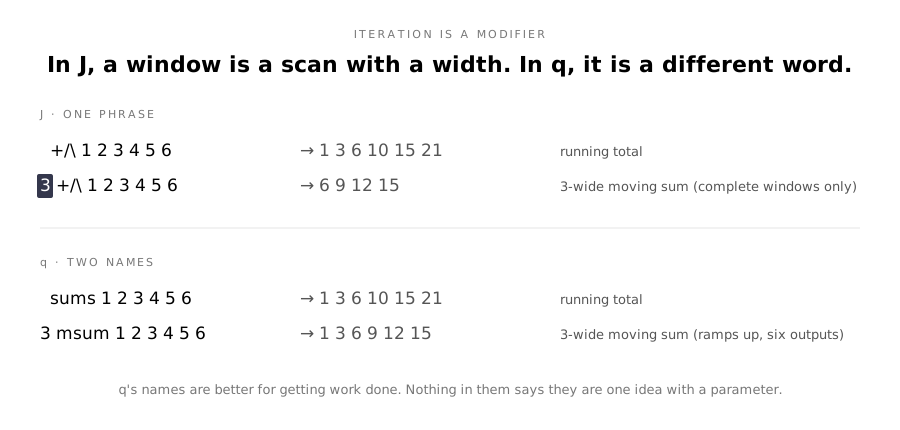
Which is a tidy observation until you see what it buys. In J, this is a running total:
+/\ 1 2 3 4 5 6
1 3 6 10 15 21
and this, the same three characters with a left argument in front, is a 3-wide moving sum:
3 +/\ 1 2 3 4 5 6
6 9 12 15
One phrase. Supply a left argument and “scan the prefixes” becomes “scan the windows” (J calls
this windowed form the infix use of \). The relationship is right there in the notation: a
window is a scan with a width.
Now q:
sums 1 2 3 4 5 6      / 1 3 6 10 15 21
3 msum 1 2 3 4 5 6    / 1 3 6 9 12 15
Two names, sums and msum. Nothing in either spelling suggests they are the same idea with a
parameter, and there is a whole m family (mavg, mmax, mmin, mcount, mdev) that you
learn as vocabulary rather than derive as a consequence.
q’s names are genuinely better for getting work done. 3 mavg px says what it means to a reader
who has never heard of an adverb. But you can hold that vocabulary completely and still not know
that iteration in this language is a thing you modify a verb with, because q never made you say
so out loud.
2. Composition is something you can write down
This is J’s party trick:
mean =: +/ % #     NB. a FORK: (sum) divided-by (count), read as one phrase
mean 0 1 2 3 4
2
# is count and % is divide. Read it left to right: sum, divided by, count. There is no
argument anywhere in that definition. J sees the shape (f g h) and builds a new verb that feeds
its argument to f and to h and combines the two with g. The mean is a noun-free sentence:
a function assembled out of functions, with the data never mentioned.
Once you have seen that, “a mean is a sum reduced against a count” stops being a sentence about arithmetic and becomes a sentence about structure. That reframing is the single most valuable thing the laboratory hands you.
And it is also the first thing that will betray you.
3. Depth is a parameter
Here is the one I think q hides most completely.
J has a conjunction, ", that sets the rank at which a verb applies: the depth of the
sub-arrays it sees. Take a 2×3 matrix ($ reshapes a list into the shape on its left):
m =: 2 3 $ 1 2 3 4 5 6
+/ m        NB. + inserted between the ITEMS — and a matrix's items are its ROWS
+/"1 m      NB. rank 1: apply to each row instead
5 7 9
6 15
The first result is 1 2 3 + 4 5 6, because “insert + between the items” means exactly that and
a matrix’s items are its rows. The second is one conjunction and a number: "1 says apply to each
rank-1 cell, so each row is summed on its own. "0 would say each atom; "2 the whole matrix.
Boxing makes the difference visible without any arithmetic in the way (< is box: it wraps
each value in a cell, and J draws the cells):
<"0 m
<"1 m
┌─┬─┬─┐
│1│2│3│
├─┼─┼─┤
│4│5│6│
└─┴─┴─┘
┌─────┬─────┐
│1 2 3│4 5 6│
└─────┴─────┘
Same verb, same argument; the number chose the depth.
q reaches the same two answers:
sum (1 2 3; 4 5 6)        / 5 7 9
sum each (1 2 3; 4 5 6)   / 6 15
but by a different route, and the route is the point. each is one fixed move, “one level
down”, with no depth to dial. There is no each 2. Where J turns a knob, q gives you a word that
only ever means 1.
Be careful how far you push that, though, because q’s other iterators are not rank in disguise:
(-':) 1 3 6 10 15 / 1 2 3 4 5 each-prior
each-prior walks adjacent pairs, which says nothing about depth, and no rank number expresses
it. J puts adjacent pairs in a different family entirely, the infix one from §1
(~ swaps a verb’s arguments, so each pair gives later minus earlier):
2 -~/\ 1 3 6 10 15
2 3 4 5
Four results where q’s -': gave five, because J’s infix takes complete pairs only, while q’s
each-prior supplies a starting prior (here 0, so the first output is 1-0). That is the same
complete-versus-partial split as the moving-window case, surfacing again in a second family. Worth
noticing now; it is about to cost us.
The practical payoff of rank is narrower than “it explains q’s iterators”, and real. The curriculum
makes the point early that each is about depth, not looping, and that the atomic operators
(+, *, >) already reach the atoms by themselves, so you never write each for those. That is
a rule you can memorise. After rank it stops being a rule and becomes a consequence: * already
applies at rank 0, so asking for each is asking for something you have.
Where the laboratory lies to you
Everything above is why the trip is worth taking. Here is the return fare. Both of these are real, both are in the curriculum’s transition chapter, and the second is by far the more dangerous.
The fork does not survive the flight
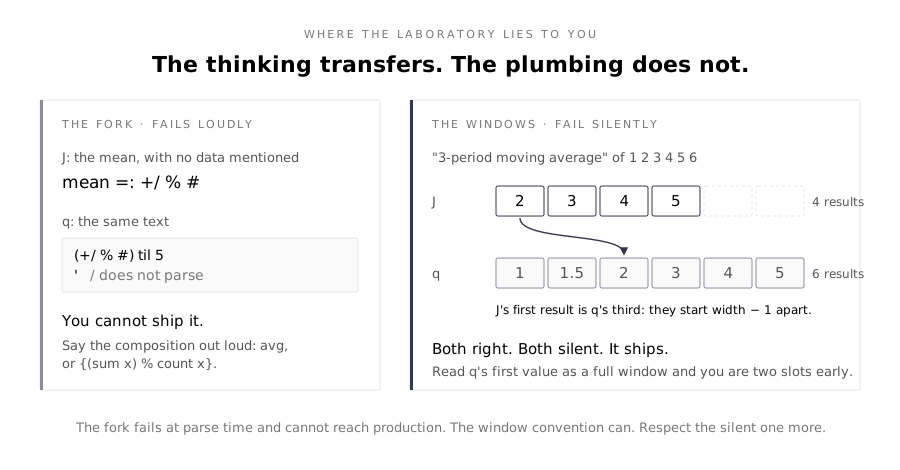
Take +/ % #, the phrase that made composition feel like a first-class thing, and type it into q:
q)(+/ % #) til 5
'                     / the error MESSAGE is blank (q also stamps the line with a wall-clock time)
  [0]  (+/ % #) til 5
          ^           / the caret lands mid-fork — where the parser gives up
It does not return the wrong answer. It does not parse. The message is blank and the caret lands in the middle of the fork.
The rejection happens at parse time, before anything runs, and that has teeth: you cannot defend against it. The reflex is to wrap the risky expression in protected evaluation and handle the failure, but the wrapper sits on the same line, and the line never parses. You can check that without a REPL by handing the text to q’s own parser as a string, which turns the failure into a value:
parses:{@[{parse x; 1b}; x; 0b]}
parses "(+/ % #) til 5"                        / 0b
parses ".[{(+/ % #) til 5};();{(`caught;x)}]"  / 0b
parses "{(sum x) % count x} til 5"             / 1b
parses returns 0b when the parser rejects the text. The fork is rejected, and so is the fork
inside a guard, because the guard’s text contains it. Notice why parses itself gets away with it:
the text arrives as a runtime string, so the parsing happens inside the protected call. That is
the only way to trap this error, and it means building code as a string on purpose, which is not a
program anyone writes by accident.
q has no tacit forks or trains. A parenthesised run of functions does not make a new function
in q, and the fork does not even parse. What q wants is for you to say the composition out loud
(2f is the float 2.0):
avg til 5                    / 2f
{(sum x) % count x} til 5    / 2f   — the explicit lambda q DOES accept
As betrayals go this one is kind, because it is loud. You cannot ship it.
The windows have a different shape, and nothing complains
This one ships fine.
J’s moving average of six numbers, three wide:
3 (+/ % #)\ 1 2 3 4 5 6
2 3 4 5
Four results. J’s infix \ gives you complete windows only. There is no 3-wide window ending
at the first or second element, so there is no output for them.
q, same request (the f on 6f makes the whole list floats):
3 mavg 1 2 3 4 5 6f / 1 1.5 2 3 4 5
Six results. q’s m family ramps up through the partial windows: the first output is the
average of one element, the second of two, and only from the third does a full window exist. Six
inputs, six outputs, always.
Neither convention is wrong. They differ silently, and “the 3-period moving average” names
both. In a q table, q’s convention lines up exactly: each row gets the
average of the window that ends at that row. The trouble is the habit you bring. Read q’s first
value as the first full window, the way J’s would be, and you are two positions early (width − 1
in general). Or keep q’s first two values without noticing, and two numbers labelled “3-period
average” are averages of one and two numbers. Either way there is no error and the answer looks
plausible. That is the exact failure shape this curriculum’s aj showcase exists to teach.
The thinking transfers. The plumbing does not. That is the rule, and both examples above are just the rule with the volume turned up and down.
Does the shift actually take? Some evidence I did not expect
I ran a controlled evaluation in late July for a different purpose, testing whether KX’s
official q plugin improves a frontier model’s q, and three of its
fifteen tasks are exactly this article’s thesis stated as an exercise: here is q that was
transliterated from an imperative loop; make it idiomatic. A do loop accumulating a sum. A
while loop building a running total. Row-index iteration over a table. Several of the
Python-to-q translation tasks probe the same instinct from the other side.
Both conditions solved all three, immediately, correctly. do[] became sum, while[] became
sums, and the row walk became one vectorised update. The loop-transliteration failure mode this
whole curriculum is built to prevent did not appear at all.
I want to be careful about how much weight that can carry, because my own verdict on that eval says it was underpowered. The fifteen tasks turned out to be easy enough that the baseline was already at the ceiling, so the study could not have detected a small effect at all. Three solved loop-fix tasks are three data points from a task set I built badly, and no evidence that models have absorbed array thinking.
What they do support is narrower and still worth something. On the loop-transliteration exercises I could think of, the failure mode this curriculum exists to prevent did not show up.
The rest of the eval does not say where the failures are, and I should not pretend it does. The
one task where both arms departed from my reference was an as-of join: both set `p# where my
task sheet expected `g#, two of q’s column attributes, the flags a table carries about how a
column is laid out. (I first wrote that up as both of them getting the attribute wrong. They didn’t. The set-attribute page says
parted applies in memory as well as on disk when the data is sorted so it can be set, and both had
sorted first.) Both arms also lost that task’s correctness point, for printing an extra block, the
table’s schema, before the answer. And a later review ran the task’s “broken” input and found that
the unsorted join already returned the right rows on that data, so the task never tested whether a
model can find a sort bug at all. That task is a record of my instrument’s defects, not evidence
about models.
J has nothing to say about sort order or attributes either. There is no fork that teaches you
`g#, and no rank that tells you when `p# is the better call.
That is consistent with a short laboratory, which is what this curriculum commits to. J was cut from co-star to an illustrative prelude on a reviewer’s advice, and it ended up as a single lesson. I went along with that at the time without evidence either way, and the eval did not supply any. The case for keeping the laboratory small is the one from the section above: the J habits that hurt you in q are the silent ones, catching them is q work, and that is where the bulk of the curriculum has to be.
Why J, and not APL or BQN
Because it is the array language I already think in, and honesty about that is worth more than a constructed justification.
If you are arriving with no destination in mind, BQN is probably the better first array language. The glyphs are more regular, the documentation is friendlier, and it was designed with hindsight about what APL got awkward. J’s advantages here are narrower and specific to this project: it is pure ASCII, so it survives any editor and any blog renderer; it is GPLv3 and needs no licence key, which makes it the one green check in this repo’s CI that does not depend on a vendor; and its fork and its rank are the two ideas I most wanted to put in front of you.
The concepts are the same wherever you meet them.
What to carry across the wall
- q will let you write the loop, and it will work. That is why q cannot teach you to stop.
- J does not forbid loops either. It makes them feel foreign, which turns out to be the more useful property.
- Iteration is a verb modifier, and a window is a scan with a width. q gives you
sumsandmsumas separate vocabulary; J shows them as one phrase with an argument. - Composition can be written down without mentioning data. Feel the fork once. Then leave it: it does not parse in q.
- Depth is a parameter, in J. q’s
eachis that idea frozen at one level, and q’s other iterators are not rank in disguise:each-priorwalks adjacent pairs, which is the infix family, not a depth. What rank buys you is knowing why you never writeeachfor*. - The thinking transfers; the plumbing does not. The fork fails loudly. The window convention fails silently. Respect the second one more.
Next in the series: “What compounds: notes from a project where everything had to run”.
Not affiliated with or endorsed by KX Systems or Jsoftware. “q”, “kdb+”, “KDB-X” and “J” are used nominatively.