

Status, before anything else: a research project on the XRP Ledger’s Devnet test network. Not audited, not production-ready, and not safe to put value behind. Its signer refuses every network but Devnet.
How to read the ids. Ids in parentheses, such as (E-58), point to rows in the project’s claims register,
CLAIMS.md. You can read the post without them. They are there so that you can check it. The letter says what kind of row it is:
- E, established: a claim, with what supports it. That is a transaction run on Devnet, a line of source code, or a document read on a stated date.
- F, a finding: a verified problem, in upstream’s standard, code or documentation, or in this project’s own.
- P, a prohibition: something this project must never claim, and why.
- R, a correction: something this project said, and later withdrew or narrowed.
- B, pending: something asserted that the evidence does not yet support.
To find a row, open the register, use your browser’s find for the id, such as
E-58, and look for it in the first column of a table. Other rows that cite it will match too. To browse by subject instead, the register has topic pages. If this post and a row ever disagree, trust the row.
Can a token move confidentially on the XRP Ledger? Yes, under a standard called
XLS-96, and today only on Devnet. A new feature reaches the XRP Ledger as an
amendment, which a network’s validators switch on. When I checked on 22 October
2026, XLS-96’s amendment, ConfidentialTransfer, was enabled on Devnet. On
Mainnet and Testnet the server software supported it, but the validators had not
switched it on. That reading goes stale; the
repository has a script that takes a fresh one.
What XLS-96 hides is narrower than the word confidential suggests. It hides balances, and the amounts of transfers between confidential balances. It does not hide who pays whom, when, or how often. It does not hide amounts entering or leaving confidential form. And it hides nothing from the token’s issuer.
I set out to find exactly where that line falls by running transactions rather than by reading the specification, and I started the same study on two ledgers at once: the XRP Ledger, and EVM chains. This post is the XRP Ledger half. The EVM results will follow in a separate post.
The XRP Ledger project is called W-CONF. Its code and claims register are public at github.com/nandanito/xrpl-confidential-positions, and a read-only demo is at xrpl-confidential-positions.vercel.app.
Why it matters: the business case
In receivables finance, a buyer pays its suppliers’ invoices some time after delivery. A supplier that needs the cash sooner can draw it from a bank against those invoices, and repay when the buyer pays. The example in this post rests on three premises about why its numbers are sensitive. They are the reasons the example was built, not findings of this project:
- A supplier’s drawings can signal its cash position. One that draws more, or more often, may be short of cash. Published, that signal reaches its competitors, its customers and its other lenders.
- The bank’s limits and balances are its book. What it has lent each supplier, and against what limit, is its exposure to each client, which it would not want a competitor to read.
- The suppliers should not see each other. A supplier that could read another’s limit and drawings would learn its position and what the bank granted it.
Why put this on a shared ledger at all? Off one, the same facility lives in several records, the bank’s and each supplier’s, which have to be reconciled. The usual case for a shared ledger is one record that the bank, the suppliers and a supervisor all read, with the money moving on that record. This post does not test that case. It tests whether the privacy the business needs survives the move.
That is the dilemma. On a public ledger in plaintext, every drawing is published, and with it each supplier’s cash position. On a private ledger, much of what a shared record was for is given up. Confidential transfers are an attempt at the middle: amounts encrypted on a public ledger, and readable by the parties who answer for the book.
So a business would ask concrete questions before using them:
- Can the public see what each supplier draws and owes?
- Can the public see who draws, and when?
- Can one supplier see another’s position?
- Can the bank see every position? It lends the money, so it must.
- Can an auditor or supervisor see them too?
- What happens if someone loses a key?
- What can the bank do to a supplier’s balance without the supplier?
The facility below answers them as it ran on Devnet. The three sections before it explain the mechanism; a reader here for the business case can skip to the facility.
What XLS-96 is, briefly
The XRP Ledger is public: anyone can read every account and every transaction. Multi-Purpose Tokens (MPTs, XLS-33) are one of its token types: an account issues a token, and other accounts hold it. XLS-96, Confidential Transfers for MPTs, lets a holder keep an MPT balance encrypted on that public ledger.
Each confidential balance is an ElGamal ciphertext, a public-key encryption of the amount. A holder registers their own encryption key when they opt in. The ledger still has to stop anyone spending more than they hold, so every transaction that spends from a confidential balance carries zero-knowledge proofs, which validators check without learning the amount.
A position moves through four transactions:
- Convert moves tokens from a public balance into the holder’s confidential inbox. The amount is published.
- Send moves an amount from one confidential balance into another holder’s inbox. The amount is hidden. The sender and receiver are not.
- MergeInbox moves the inbox into the balance the holder can spend. Arrivals wait in the inbox so that they cannot change a balance while a proof about it is being built, and they cannot be sent until they are merged.
- ConvertBack moves tokens back to a public balance. The amount is published.
Only Send hides an amount.
The specification, XLS-0096, is the work of Murat Cenk, Aanchal Malhotra, Ayo
Akinyele, Peter Chen, Shawn Xie and Yinyi Qian, and is a final standard (E-1). The
compact sigma protocol, one of the zero-knowledge proofs behind a Send, is the work
of Tess Dore and Murat Cenk at RippleX Research. The reference cryptography is
XRPLF/mpt-crypto. This project builds on
their work and claims none of it.
Upstream’s code has had three outside reviews. None of them reviewed this project, which has had no outside audit. Trail of Bits reviewed upstream’s Confidential Transfer implementation in April 2026; that report is the one I could read and check my findings against, and a later revision of it could not be obtained. The Sherlock XRP Ledger Attackathon was a contest that covered Confidential Transfers, and its findings are not public. A Zellic scan of mpt-crypto is known to me only through three identifiers an upstream issue cites. Of the three reviews, only Trail of Bits’ April report could be checked.
What it hides, and what it does not
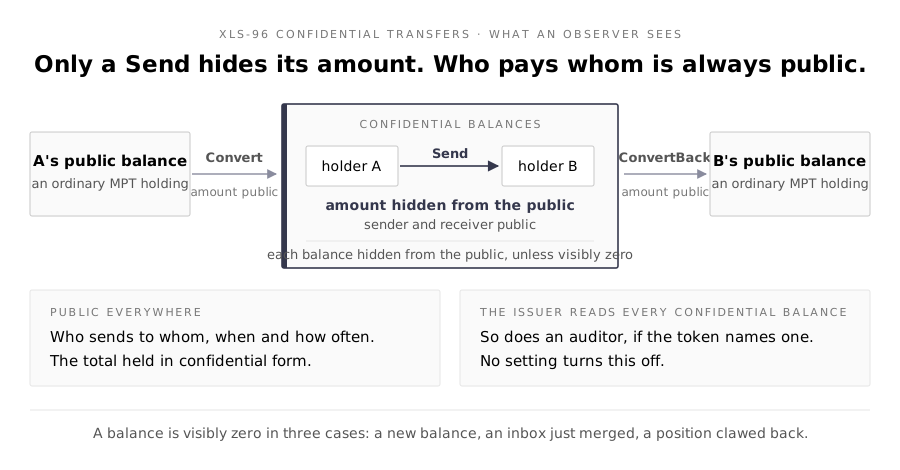
Hidden from the public: each holder’s balance, and the amount of each Send.
Public, always:
- The sender and receiver of every transfer, and when it happened, so how often anyone transacts (P-4, P-11).
- Every amount converted in or out, each one separately.
- The token’s total supply, and the total held in confidential form.
- That a balance is exactly zero, in three cases, below.
Who can read every balance: the issuer, always. XLS-96 keeps a second copy of each confidential balance, encrypted to the issuer’s key, and no setting turns it off (P-9). An auditor can read them too, if the token names one, and only one is supported (E-11). I ran this rather than inferring it. The holder, the issuer and the auditor each decrypted the same balance, 500, and each read 475 after a 25-unit Send (E-58).
Who can spend: only whoever holds the holder’s encryption secret, because a Send’s proof cannot be made without it (E-33). Where that secret is derived from the account’s master seed, as this project derives it, whoever holds the seed holds the secret too. The issuer cannot spend a holder’s balance. If the token allows clawback, a setting that lets an issuer take tokens back, the issuer can destroy a confidential balance, crediting no one, and this project’s tokens allow clawback (E-12). Unless the token’s flags were made unchangeable when it was created, the issuer can also turn on locking later and freeze balances. That second power I read in rippled’s source and did not run (E-290).
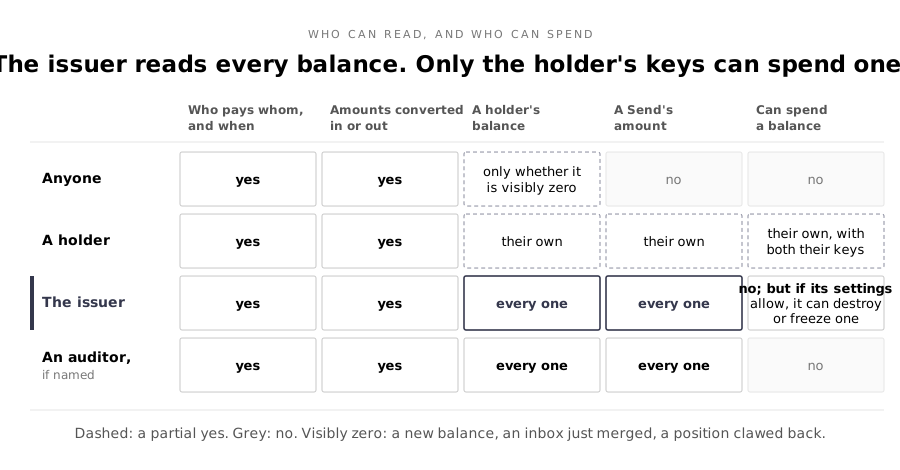
Zero is sometimes visible. XLS-96 writes a fixed encryption of zero, which anyone can recompute from public inputs, in three places: a new confidential balance, an inbox that a MergeInbox has just emptied, and a position clawed back. So enrolment is publicly visible. The English documentation said this value could not be told apart from other ciphertexts. I recomputed it from public inputs and matched it byte for byte against live Devnet state (F-1, E-59), reported it, and the English page was corrected. A balance spent down to zero is different: it holds a randomised encryption of zero, and looks like any other balance (E-211).
The public numbers bound the hidden ones. If a holder converts in 500, receives nothing, and converts back 400, anyone can work out that the other 100 is either still held or has left by confidential Send. No key is needed. I first wrote that the 100 “left by transfer”. That overstated what an observer learns, and it is recorded as a correction (R-7).
No rotation, no recovery
A registered key can never be changed (E-9). XLS-96 has no key rotation and no key recovery (P-10). A holder who loses their encryption key loses access to the balance (E-10). In this project the key is derived from the account’s master seed, so it can be re-derived while the seed survives; lose both, and the balance cannot be spent. If the token allows clawback, the issuer can remove such a balance, and a clawback destroys it.
A draft standard, XLS-99, by Aanchal Malhotra and Yinyi Qian, proposes rotation for holder, issuer and auditor keys, and recovery from key loss. When I checked, rippled declared its amendment as not supported, in its development branch and in its latest release candidate, and Mainnet, Testnet and Devnet did not know it (E-353). So there is no rotation or recovery in XLS-96, or on Mainnet, Testnet or Devnet, today.
The example: a confidential receivables facility
To test the standard against that business case, I built the core of such a facility.
The bank issues a token. An ordinary XRPL account, which this project calls the Dedicated Account, holds the float, the bank’s money that the facility advances, and converts it into confidential form once. Suppliers enrol, draw down by confidential Send, and repay the same way. At the end, what is left of the float is retired in several parts, called tranches, by ConvertBack. It ran on Devnet in 28 validated facility transactions, besides setting up the token (E-146).
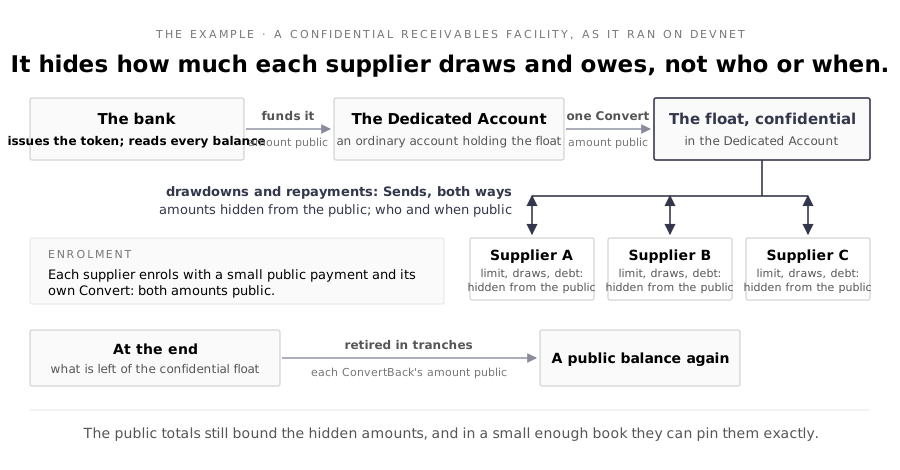
Anyone can see the size of the float, because converting it publishes the amount. They can see which suppliers enrolled, who drew and repaid, on which days, and how often. And they can see the size of every retirement tranche, because each ConvertBack publishes its own amount (F-24). My own walkthrough first said a ConvertBack published only “the aggregate change”. The validated transactions showed each tranche in plaintext.
Hidden from the public: each supplier’s limit, the size of each drawdown and repayment, and what each supplier still owes. The bank, as issuer, sees all of it. The public totals still bound these amounts, and in a small enough book they can pin them exactly.
So it hides how much each supplier draws and owes. It does not hide who borrows, when, how often, or the size of the whole. An early version of the design claimed the facility “shows nothing about which supplier drew how much” (R-1). Which supplier drew, and when, is public.
Against the business case’s questions:
- What each supplier draws and owes: hidden from the public, though the public totals bound it.
- Who draws, and when: public (P-11). A supplier that moves from monthly to weekly drawings shows as short of cash without one amount being known. One proposed remedy, the float sending to every supplier on a fixed schedule whether or not money moves, has not been shown to work, so I do not offer it as one (B-10).
- One supplier, another’s position: hidden from it, as from the public. Each holder’s key decrypts its own balance (E-52).
- The bank: reads every position, always (P-9).
- An auditor: reads every position too, if the token names one, and only one is supported (E-11). That is a statement about who can decrypt what, not a claim that it meets any regulator’s requirements (P-6).
- A lost key: if a supplier loses its key and the seed it was derived from, the balance cannot be spent (P-10, E-10). If the token allows clawback, the bank can remove it, and a clawback destroys it (E-12).
- The bank, as issuer: it cannot spend a supplier’s balance. If the token’s settings allow, it can destroy one or freeze one (E-12, E-290).
So the business case holds for amounts and fails for relationships. A supplier that minds being seen to borrow at all, or how often, gets no cover from XLS-96.
Two limits of that run. First, it read the ledger through a public Devnet node. The design requires a node on the same machine, and a local Devnet node never finished syncing on the hardware I had, so I accepted that as a named risk (E-148, E-151). The run says nothing about that requirement. Second, one test driver played the bank and every supplier and held every seed. The run shows that these transactions are well formed and that rippled accepts them. It does not show how custody would work.
Reading the specification, and running it
Several of the things above I learned only by running them:
- That three different keys decrypt the same balance, through a change (E-58).
- That the encryption of zero matches a value anyone can recompute (F-1).
- That a balance spent to zero is not recognisable. My own observer page had labelled every ciphertext that was not the fixed zero as “Non-zero”, and a holder whose balance decrypted to 0 disproved it (E-211).
- That a failing transaction is not simply rejected. A
tecresult, one class of XRPL failure code, is still applied to the ledger: the fee is charged and the account’s sequence number is used, though what the transaction asked for does not happen. The submission parameterfail_hardasks the node to discard it instead. I ran both on Devnet with a plain Payment that fails withtecNO_AUTH: the same signed bytes were applied without the flag, and discarded with it (E-149).
That last one matters more for confidential transactions than for plain ones,
because a tec keeps the transaction’s fields, ciphertexts included. If a signer
reads a wrong destination key from a dishonest node, the amount is published
encrypted to that key for good, even though the transaction fails. That case I read
in rippled’s source and did not run (F-23).
Running is not a substitute for reading what others have already found. Several things I first recorded as findings turned out to be issues that Trail of Bits’ review had already found and Ripple had fixed.
What the reviews caught
Design decisions and fixes went through rounds of adversarial review. These were the project’s own reviews: not outside audits, and not reviews by outside security professionals. Each round gave its review passes deliberately different material, so that their agreement would mean more than one reading copied three times. The repository keeps more than sixty numbered review records, including the ones that found me wrong. A few of the catches:
- A secret not wiped from memory, behind a comment explaining why it could not be. The comment said the secret’s type belonged to an outside library. It was the project’s own type, and one search of its file showed it had no wiping at all (E-200).
- A design claim that four review passes independently ruled unsound. I had written that the project’s local read-only web viewer “moves no trust boundary”. It added no signing authority. But it re-served, to any local user, data the project protects with file permissions (E-230). That was the viewer that runs on the holder’s machine, before the hosted demo existed; the demo serves only static files.
- A release gate that passed a Content Security Policy every browser refused. The gate hashed inline scripts over the file’s bytes. Browsers hash the text they parse, which differs. Only loading the pages in a real browser showed it (E-334).
- Fixes that did not fix. In one review’s second round, five of the first round’s fixes had not discharged their findings. Only the review pass that ran each finding’s own example against the fixed code found them (E-345).
The lesson I keep relearning: fixing something and describing the fix are two acts that fail separately. A review that reads my summary of a finding will tick the summary.
Checks that catch a false sentence
The working rule is that a claim needs its evidence before it is written. The claims register holds each established claim with what supports it, and twelve standing prohibitions, P-1 to P-12, on what may not be claimed at all: that XLS-96 hides identities, that holders are private from the issuer, that it supports key rotation, any benchmark without its hardware and method, and any claim that a source does not say something without the search that would show otherwise.
Prose drifts anyway, so some of it is enforced by checks that run in CI. One fails when a retracted phrase reappears without its correction. One fails when a note meant for upstream says something is missing from a source and does not record the search that found it missing. One keeps the register’s derived indexes in step with it.
They do not catch everything. The register keeps nine correction records, R-1 to R-9. Most withdraw or narrow something this project claimed; one records a retraction that was itself reversed. R-8 said every confidential transaction needs both of a holder’s keys, when a MergeInbox needs only the account key; it was on the public demo until a review pass found it repeated in a diagram caption. R-9 came from reviewing this post. The README and the demo summarised the facility as hiding “the shape of the book, not its size”, and a reader new to the project took shape to mean who borrows and when, which is public. That sentence is replaced everywhere, and a check now refuses it.
At one point the register still listed as open four filings that upstream had already fixed (E-316). Nothing re-checked them until I surveyed every filing at source. That survey now runs before anything I publish about them, this post included.
What went upstream
This project has filed eleven issues in four XRPLF repositories. Their state when I checked, read at source (E-353):
- Four resolved. Three issues against the XLS-0096 text, resolved in the merged standard, and a fourth against the documentation: its sentence calling the zero value indistinguishable was corrected on the English page. The Japanese translation was made from the text before the fix, and still carries it.
- The mpt-crypto build. Its lockfile pinned an OpenSSL revision that the documented package remote did not serve. Fixed on mpt-crypto’s main branch, not yet in a release. I re-ran the check against the merged commit, and it resolves.
- The fixed zero, from JavaScript. mpt-crypto’s WASM and npm packages did not expose the function that computes the fixed encryption of zero, which is the check an outside observer most needs. A maintainer agreed and a pull request is approved and not merged. I have offered to write the JavaScript wrapper once it is released.
- Three filed most recently, against mpt-crypto, with no reply yet: an ambiguity in what the compact sigma paper’s nonce input covers; a WASM build script that fails outside its pinned toolchain; and a proof-size total in the paper that assumes a ciphertext component is sent once, where rippled and XLS-0096 send it per recipient.
- A question to XRPL-Standards, whether a confidential balance is meant to stay invisible to the accounting of the ledger’s vaults (XLS-65), which pool one asset and issue shares against it, has had no reply in nearly two months.
- A filing to rippled that listed only things done well was closed without comment the day it was filed, so its reason is not known. It also fit neither of that repository’s two issue templates, and the project’s filing rules now forbid a positives-only filing to a bug tracker.
I do not call any of these new, or unreported. Of the three outside reviews of upstream’s code, I could check my findings against one.
What it does not show
- No run against a local node. Every Devnet read went to the public cluster (E-151).
- Custody is a named risk, not solved. The issuer can erase or freeze the facility’s float. The Dedicated Account’s key both moves the float and decrypts every amount sent to or from it, so those two powers cannot be held apart (E-266).
- The key derivation is unpublished. It is specified in this repository only, so a holder with their master seed but not this repository cannot reconstruct their key. Treat it as lock-in until it is published.
- A hostile process running as the same user can read the encryption secret out of memory.
Try it
The demo is static pages built from one snapshot of Devnet. It signs nothing and holds no keys. It shows what an observer reads of four test accounts, including which balances are visibly zero; which encrypted copies the issuer can read, without publishing the figures; and what each kind of key can do. It does not show the facility, whose record is in the repository.
To transact, you run the signer yourself, on your own machine. The README explains how to build it and run the local version of the site. It does not yet walk through creating a holder profile and funded Devnet accounts, which a transaction needs.
The repository has the Rust signer, the TypeScript facility, the read-only web viewer, the claims register and the review records, under Apache-2.0.
What to take from it
- XLS-96 hides amounts, not relationships. Balances and Send amounts are hidden from the public. Who pays whom, when and how often is not. In a receivables facility, that protects each supplier’s figures, and not the fact or the rhythm of its borrowing.
- The edges are public. Every Convert and ConvertBack publishes its amount, and the totals bound what is hidden.
- The issuer reads every amount. It reads every balance and Send amount and, if the token’s settings allow, can destroy or freeze a balance.
- Keys cannot be rotated or recovered, in XLS-96 or on Mainnet, Testnet or Devnet today. XLS-99 is a draft that would add both.
- Running it found things reading did not, and reading what others had already found saved me from calling their findings mine.
Next: the same study on EVM chains.
If something in this is wrong, please tell me, by an issue on the repository. The register has a section for corrections, and it has nine entries.
References
- XLS-0096, Confidential Transfers for MPTs: XRPLF/XRPL-Standards
- XLS-0099, ElGamal Key Rotation for Confidential MPTs (draft): XRPLF/XRPL-Standards
- The reference cryptography: XRPLF/mpt-crypto
- Confidential Transfers on xrpl.org: English
- This project: repository, demo, claims register, what confidential means, at length, the facility walkthrough, the filings and their outcomes, the latest filing survey
Independent work. Not affiliated with or endorsed by Ripple. “XRP Ledger”, “XRPL” and “Ripple” are used nominatively.