

Article 2 of 5 in the array-thinking-to-q series.
I set out to answer a narrow question with an experiment instead of an opinion: does KX’s official Claude Code plugin for q measurably improve a frontier model’s q output?
The answer, on fifteen paired tasks, is that I could not measure any improvement, and the more useful finding is why I could not. The comparison ran, but it could not tell the two arms apart. That is a different and more interesting result than “the plugin doesn’t help”, and the distance between those two sentences is most of what this article is about.
Why this experiment exists at all
I am writing a curriculum that teaches array thinking through q. The original plan included authoring a q skill for Claude Code. Then I found that KX already ships a family of official plugins, covering q, PyKX, KDB-X and KDB.AI among others, with their own marketplace and a qlint integration.
If you do not use Claude Code: a plugin there is a package that can bundle skills, agents, hooks
and tool servers. A skill is a folder of written guidance that the model loads into its context
when a request looks relevant. It does not change the model; it changes what the model has read
just before it answers. KX’s q plugin, at the commit I tested, was two skills: the q guidance
itself, and qlint-snippet, which runs KX’s linter over a piece of q. The guidance is exactly the
kind this curriculum cares about: write q the way q wants to be written, reach for whole-list
operations instead of loops, avoid the known traps.
A competing q skill would be redundant, so the deliverable became an independent evaluation of KX’s, with authoring gated behind the eval finding a gap. The protocol committed, before any data existed, to publishing whatever came back.
Reading the answers: two q idioms in two minutes
New to q? It is the language of kdb+, a column-oriented time-series database best known in finance. Article 1 has a one-minute primer on array languages. This section is the minimum you need to read the answers below.
The eval scored answers on idiomaticity as well as correctness: not just “does it print the right
thing” but “is this how q is meant to be written”. What that means is easiest to see in the answers
themselves. Both below are real answers from the eval, and make verify runs them.
One task handed the model a while loop that built running totals the way most of us learned to:
an index, an accumulator, an output list, and three updates on every pass. Both conditions threw all
of it away and wrote this:
x:5 3 8 1;
show sums x;
sums is a running total over the whole list, and it prints 5 8 16 17. The loop spelled out
how to walk the list; sums names what you want from it. The index and the accumulator were
never part of the problem, only of one way of solving it. That move, from steps to a description
of the result, is the reflex the whole curriculum is about.
And the database side. q has a SQL-like layer, qSQL, that runs over in-memory tables:
t:([] sym:`AAPL`AAPL`MSFT`AAPL`MSFT; side:`buy`sell`buy`buy`sell)
show select n:count i by sym,side from t
i is the row number, so count i counts the rows in each sym/side group. It returns a small
keyed table: AAPL buy 2, the other three pairs 1. The imperative instinct here is a loop over rows
that bumps a counter per key. Both conditions wrote this line character for character.
Keep those two in mind. They are what “idiomatic” looked like in this eval, and the model wrote them without any plugin’s help, which is most of the story that follows.
The design, in brief
Subject: q-knowledge@kx-skills, pinned at commit 8b7040f (plugin v0.1.0). There is no version
tag upstream, so the SHA is the pin. What this run actually tested is the q guidance skill.
qlint-snippet needs KX’s linter installed locally and a shell to run it, and my harness had
neither: in Part B the model invoked it four times and the lint never ran. The plugin’s self-checking path is
untested here, and nothing below speaks for it.
Dated note, 2026-09-28. KX has kept shipping since this run. On 14 Aug it bundled a documentation-search MCP server into
q-knowledge(now 0.1.1) and its five sibling knowledge plugins; it has also added new plugins and Codex support. The q skill’s own content is byte-identical to the pinned commit (I checked the tree hashes). So every number below still describes exactly what I tested, but the plugin you install today also bundles a KX documentation search, and this eval did not test that. My harness allowed onlySkill,ReadandGlob(with one leak, below); a re-run would first have to decide whether to let the docs server in.
Conditions: A = baseline, no plugin. B = that plugin loaded. Identical prompts, identical
model (claude-opus-5), identical settings, with one exception I found only when an adversarial
review re-read the raw logs. In three condition-B sessions (tasks 03, 04 and 06), a claude.ai Google
Drive connector on my account had finished connecting before the session started, and eight of its
tools were listed in the session’s context; in their condition-A twins it was still pending, so the
three intended tools were all there was. That could happen because the order was fixed: all fifteen
A sessions ran first, then all fifteen B sessions, about two minutes later. None of those tools was
ever called and all three pairs scored identically, so no scored result turns on it; dropping those
pairs moves the output-token ratio below from 2.8× to 3.4×. But those three pairs were not isolated
by the plugin alone, and I should have pinned the connectors off rather than trusting the tool flag.
Part A: does it fire? A skill that never activates is worth zero regardless of content.
20 prompts: 10 that should fire, 10 adjacent traps that should not (NumPy vectorization, plain
SQL, BQN trains, merge_asof in pandas, “group a JavaScript array by a key”).
Part B: is the output better? 15 q tasks (translate from Python, write from an English spec, fix a deliberately unidiomatic solution), each run under both conditions. Correctness by exact golden-file diff. Idiomaticity as a five-item binary checklist, never a 1–5 “feel” score, because a feel score drifts upward as my own q taste improves while the benchmark stays fixed. Every checklist item has to be justifiable against a published source, Q for Mortals or code.kx.com, rather than against my preferences. (One item did not live up to that, and it is the one that decided the only discordant pair; more below. Another, “uses qSQL where a table op is expected”, scored a pass on all thirty answers, including tasks with no table in them, so it added a point to both arms equally and discriminated nothing.)
Decision rule, fixed in advance: a heuristic in the spirit of a paired sign test. Count only the tasks where the two conditions differ; the effect is real only if one side takes ≥~80% of them. (It is not an exact test, and it is looser than one: a two-sided exact sign test cannot reach 5% significance with fewer than six discordant pairs, because even 5–0 gives p = 0.0625.)
I want to flag one thing I am not claiming. The scoring was not blinded. At the time I told myself it could not be, because idiomatic q gives away its condition. That was wrong: the saved answers are code only, five pairs turned out identical, and relabelling the thirty files with random IDs before scoring would have cost minutes. The published-source requirement on every checklist item is the defence I did use against evaluator drift. It is weaker than blinding, most of all on the one pair that turned on a judgement call. A blinded rescore of the committed answers is the cheapest improvement anyone repeating this could make.
The control that decided whether any of this meant anything
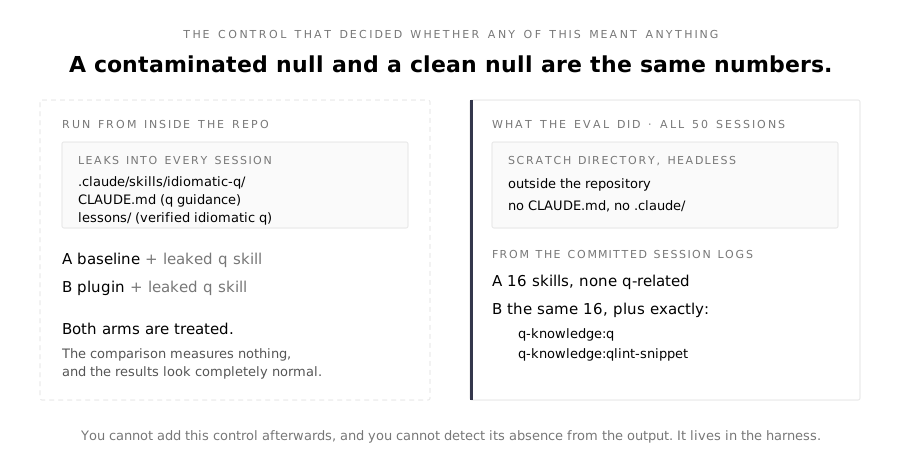
My repository contains .claude/skills/idiomatic-q/SKILL.md. It carries anti-loop rules, “prefer
qSQL over row-wise thinking”, and the aj sort-discipline gotchas. The root CLAUDE.md adds more
q guidance. The lessons/ directory is full of verified idiomatic q.
Run the eval with Claude Code from inside that working copy and condition A is not a baseline. It silently inherits a q idiom skill, which is approximately the thing under test. Both arms get treated, the comparison measures nothing, and the results look completely normal. That is the part that should scare you. A contaminated null and a clean null are the same numbers.
So every one of the 50 sessions ran headless from a scratch directory outside the repository, with
no CLAUDE.md and no .claude/. The committed session logs record what each session loaded: every condition-A session had the same 16 skills,
none q-related, and specifically no idiomatic-q. Every condition-B session had the same 16 plus
exactly q-knowledge:q and q-knowledge:qlint-snippet.
The general form: when the environment can leak the treatment into the control, that control is a property of your harness, not of your analysis. You cannot add it afterwards, and you cannot detect its absence from the output.
Part A: it fires
8/10 on should-fire. 9/10 on the traps.
The two should-fire misses are my instrument’s fault, not the plugin’s. Both prompts say “fix this q code” and “convert this list comprehension”, and my table supplies no code. In an empty directory the model searched for a file, found none, and asked me to paste the snippet. It never attempted q, so there was nothing for a skill to help with.
My first draft called that “8/8 on the well-formed prompts”. It isn’t: choosing your denominator after you have seen which items missed is overfitting. The recall this instrument measured is 8/10; repaired prompts would be a different test set and need a fresh run.
The single false positive was “Write a query to fetch users by email”, answered entirely in q,
schema and all. Good q; an answer to a question nobody asked in q. Two caveats keep me from making
much of it: my harness deliberately strips all ambient context, so q-knowledge was the only
domain skill on the bench, and every trap built to bait a keyword match (merge_asof, “group”,
J’s rank operator) held firm. The mis-fire came from the least q-flavoured prompt in the set.
The reason Part A matters is that it forecloses the easy explanation for what comes next. In Part B the plugin’s q skill was invoked in 14 of 15 runs. Whatever follows is a finding about an active plugin.
Firing was decided mechanically, from a Skill tool call in the session log, not by whether
the answer looked like q: one prompt produced fluent q with no skill loaded at all.
Part B: the ceiling
All 30 answers were collected and saved first, then scored in one pass, both conditions side by side. Here is what came back.
| condition A (baseline) | condition B (plugin) | |
|---|---|---|
| Correctness | 14/15 | 14/15 |
| Idiomaticity | 73/75 | 74/75 |
| Discordant pairs | 1 | |
| Wins | 0 | 1 |
Two scoring calls sit inside the idiomaticity row, both explained below: rescore task 15 as KX’s documentation supports and it reads 74/75 against 75/75; count task 08 as a tie too and it is 75/75 each, with no discordant pair at all.
One discordant pair is far below the roughly five my rule needed before it could say anything. Even an exact two-sided sign test needs six, all one way, to reach 5% significance; on one pair it gives p = 1.0. The decision rule never had anything to decide.
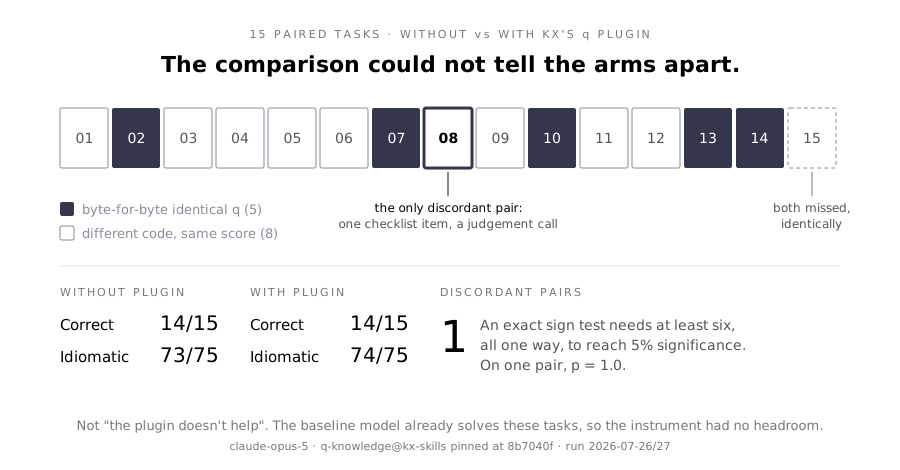
And that one pair is thin. It turns entirely on whether writing
t:update notional:price*qty from t
show t
instead of
show update notional:price*qty from t
counts as an unnecessary binding. Under the rule I fixed before scoring (a candidate fails the
“no unnecessary temporaries” item only if it introduces a binding the verified reference solution
does not need), it does. But the task said “add a column notional … and show the result”, and
mutating the table is a defensible reading of “add”. A second scorer could call it a tie without
straining. A margin that flips on one person’s reading of one line is not a margin.
Meanwhile five of the fifteen task pairs came back byte-for-byte identical, including two you
met above: the select … by sym,side and the sums x that replaced the while loop. Another was
simply show sums 1 2 3 4 5.
This is a ceiling, and it is the honest headline. The tasks cannot discriminate between the
conditions because baseline claude-opus-5 already solves them.
The mistake I made, stated plainly
I wrote fifteen tasks that were easy to verify. Every one has a reference solution that runs and a golden output that diffs. That discipline is what makes the eval trustworthy, and the way I got it is what broke the eval: I kept verification simple by choosing simple tasks, and simple tasks left no headroom. “Sum of squares.” “Total qty by sym.” A frontier model in 2026 does not need help with these from anyone. Exact-output checking does not require easy tasks; I just did not write any hard ones.
The fix costs an hour and I did not spend it: run the baseline arm alone first, and check that it fails often enough to leave room for the treatment to show. Fifteen sessions would have told me this task set had no headroom, before I spent fifty on a comparison that could not resolve.
What did separate the conditions
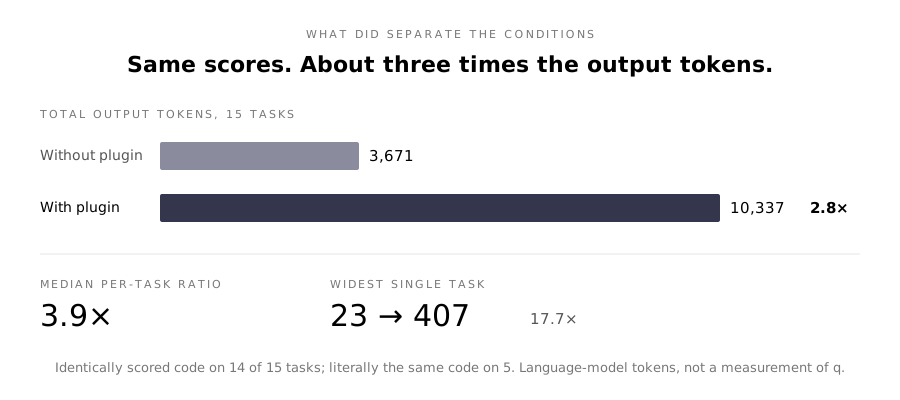
The tasks could not discriminate on quality. They did separate cleanly on output tokens.
| A | B | ratio | |
|---|---|---|---|
| Total output tokens, 15 tasks | 3,671 | 10,337 | 2.8× |
| Median per-task ratio | 3.9× | ||
| Widest single task | 23 | 407 | 17.7× |
Roughly three times the output tokens, for code that scored identically on fourteen of fifteen tasks and was literally the same code on five of them. (The session logs’ own dollar figures, which also count input and cache tokens, put the gap at about 4.5×: $0.47 against $2.10 for the fifteen tasks.) When your primary metric hits a ceiling, the secondary metrics are the finding.
The one genuinely interesting finding, which turned out to be mine, not theirs
Task 15 is about the as-of join: for each trade, find the most recent quote at or before the
trade’s time. q’s aj does this in one call, and it assumes the quote table is sorted by time
within each symbol; when it is not, aj can return the wrong quote without complaint (lesson 04 of
the curriculum shows it happening, with verified output). The task handed the model a join over an
unsorted quote table, said it was returning wrong quotes, and asked for a fix and the appropriate
in-memory attribute. An attribute is a flag you put on a column to promise q something about how its values
are laid out: `g# (grouped) has q keep an index from each distinct value to the rows that hold it;
`p# (parted) promises that equal values sit together in contiguous runs. (The as-of join gets its own article, the next in this series.)
The premise was false, and I did not know until the last adversarial review ran the task’s own code on the pinned build: with this particular data, the unsorted join returns the right rows anyway. Task 15 never contained the bug it described. Both models were asked to repair a join that worked, did what the prompt said, and could not have been credited for spotting a bug that was not there. Nothing in the scores moves (both arms missed this task for an unrelated reason, an extra output line), but the instrument is wrong in a second way, and the fix is the discipline this repo applies to everything else: a task that claims a bug must be run and shown to fail before it is used. I checked that my reference passed. That is not the same check.
Both conditions sorted the table, produced the correct joined table, and applied `p# where
my task sheet cites `g#.
I first wrote this section up as a finding, and I had it wrong. The draft said both arms had
reached for “the disk attribute on an in-memory table”, citing the aj
page, which frames the pair as memory → `g#, disk →
`p#. Then the sibling page: set-attribute says
parted applies in memory as well as on disk, whenever the data can be sorted so that it can be set.
Both candidates sorted the table first. That is precisely the precondition. `p# there is
defensible.
So the honest version of this section is much smaller than the one I wanted to write. There is no “KX’s plugin failed to correct a deviation from KX’s own guidance.” There is: both arms diverged from my task sheet, in a direction the documentation supports, and my task sheet is the thing that was too narrow. It names one attribute as though it were the only right answer.
I have left the score at zero, because the scoring rule was fixed before the pass and gets applied consistently or it is not a rule; the sensitivity note under the results table shows what changes if it is not. Both arms diverged identically, so it never touched the comparison. It was also the eval’s only candidate “gap”, and it turned out to be a defect in my own instrument.
What I would tell you to steal
- Establish your baseline’s failure rate before designing the comparison. Otherwise you build an instrument with no headroom and find out fifty sessions later.
- Measure activation as a tool call, not a vibe. Fluent domain output is not evidence that a domain skill loaded.
- Build the harness so it cannot leak the treatment into the control, and verify that from the session logs, not by assuming (or by asking the model). A contaminated null is indistinguishable from a clean one.
Verdict
No measurable lift, on a task set with almost no room to show one. KX’s q-knowledge guidance, as
pinned at 8b7040f, activates reliably and writes good q (its linter path was not tested). So does
the model without it, on tasks this easy, for about a third of the output tokens. No skill authored.
The failure mode generalises far past q: an A/B against a frontier model is measuring your task set at least as much as your treatment, and if you did not check the baseline for headroom first, a null result is telling you about your benchmark, not about the thing you were testing.
Everything behind this: eval/verdict.md for the full writeup and the
threats-to-validity list, eval/runs/ for all 30 answers verbatim and the
per-task scoring rationale, eval/harness/ for the scripts. The correctness
column recomputes from the committed answers with one command.
Not affiliated with or endorsed by KX Systems. “q”, “kdb+” and “KDB-X” are used nominatively.