

Article 3 of 5 in the array-thinking-to-q series.
Provenance. Every q and J snippet below is copied from lesson 05, whose outputs
make verifyre-captures from KDB-X CE 5.0 and J 9.7.1 and diffs against the page. No output here was typed by hand. There are no timings or speed claims here, deliberately. Clause 9 of the KDB-X Community Edition licence reads: “You will not disclose any benchmark, test or performance information or any report which contains a competitive analysis regarding the Software to any third party except as explicitly authorized in advance by us in writing.” Staying well clear of it is my choice of caution, not a reading of where that line falls. Where the article says one shape looks at less of the data than another, that is a statement about what the code does, which you can check by reading it, not a measurement (licensing notes). Everything below is about what the join does and why it is shaped that way, which it turns out is the more interesting half anyway.
New to q? It is the language of kdb+, a column-oriented time-series database best known in finance. Article 1 has a one-minute primer on array languages. Beyond that, this article explains each piece of q syntax the first time it appears, so you can read every snippet without having written q before.
There is a sentence people like to write about q, and it goes something like: kdb+ has the as-of join, and that is why trading firms pay for it.
I don’t want to write that sentence, for two reasons. The first is that I can’t back it up: the
licence I run q under (Clause 9, quoted at the top) restricts publishing the numbers that sentence
implies. The second is better. It isn’t true in the way it sounds. pandas has merge_asof.
Polars has join_asof.
DuckDB, QuestDB and ClickHouse all have an ASOF JOIN. The as-of join is not rare and it is not
q’s secret. It exists wherever time series meet, because the question it answers is one every
time-series programmer eventually asks:
For each trade, what was the quote in force when it happened?
Not a quote at exactly that time (there usually isn’t one), but the most recent quote for the same symbol at or before it.
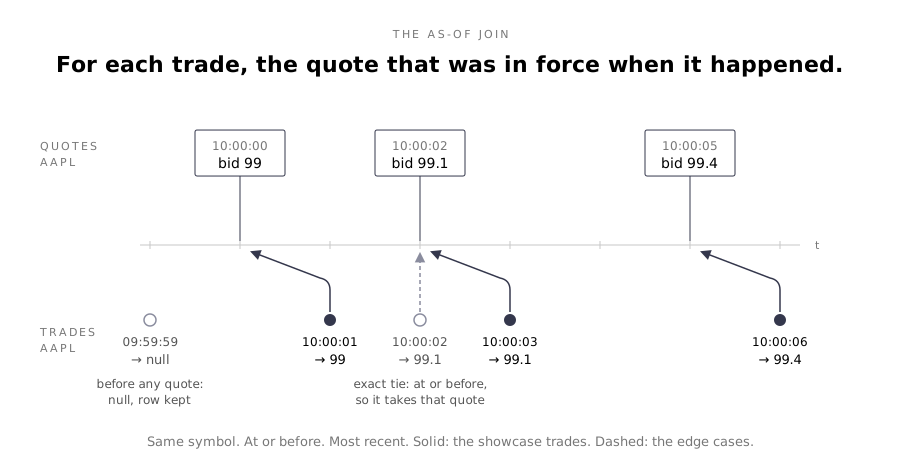
So if the join isn’t the story, what is? After building the lesson around it, my answer is: the
story is what the join looks like when the language, the table layout and the storage were all
designed around it. In q, aj turns out to be barely a function at all. It is two primitives you
already know, standing on a sort you are responsible for, and every edge case of the join is
settled before you write a line.
The data
Two small tables. In q a table is written as named columns, each a list of values; `AAPL is a
symbol (an interned string, the backtick marks it) and 10:00:02 is a time. Here are the quotes,
in the order they arrived, which is not time order:
quote:([] sym :`AAPL`MSFT`AAPL`MSFT`AAPL;
          time:10:00:02 10:00:04 10:00:00 10:00:01 10:00:05;
          bid :99.1 200.3 99.0 200.0 99.4;
          ask :99.3 200.5 99.2 200.2 99.6 )
sym  time     bid   ask
-------------------------
AAPL 10:00:02 99.1  99.3
MSFT 10:00:04 200.3 200.5
AAPL 10:00:00 99    99.2
MSFT 10:00:01 200   200.2
AAPL 10:00:05 99.4  99.6
And the trades we want to price:
trade:([] sym :`AAPL`AAPL`MSFT`AAPL`MSFT;
          time:10:00:01 10:00:03 10:00:02 10:00:06 10:00:06;
          price:99.15 99.25 200.1 99.5 200.4;
          size:100 200 50 150 75 )
sym  time     price size
------------------------
AAPL 10:00:01 99.15 100
AAPL 10:00:03 99.25 200
MSFT 10:00:02 200.1 50
AAPL 10:00:06 99.5  150
MSFT 10:00:06 200.4 75
The loop you would write first
Here is the imperative definition, written down directly. In SQL it would be a correlated subquery; in q it is a function applied to each trade:
prevailing:{[s;t] exec last bid where time=max time from quote where sym=s, time<=t}
prevailing'[trade`sym; trade`time]
99 99.1 200 99.4 200.3
Read it left to right. {[s;t] …} is a function of a symbol s and a time t. Inside it,
exec … from quote where … is q’s SQL-like query form, returning plain values rather than a table.
trade`sym is the sym column of trade as a list, and the ' after prevailing (read
“each”) calls the function once per pair of symbol and time.
Right answers. And the function deserves credit for something real: it does not care what order the
quote rows are in. “The quote with the greatest time at or before t” is a statement about
values. Shuffle the table and it stays true, with one exception that turns out to matter: if
two quotes share a timestamp, “the greatest time” names both, and only row order can break the tie.
That is why it says last bid; we will come back to it.
What it gets wrong is the shape of the work. Every trade filters the whole quote table by symbol, filters again by time, then scans the survivors for a maximum. And inside that, it asks two different questions and treats them the same way:
- Which quotes belong to this symbol? That depends only on the symbol, yet it’s recomputed for every trade, including three AAPL trades asking about the same AAPL.
- Of those, which is the latest at or before
t? This one genuinely depends on the trade. But it’s answered by looking at every candidate, as though quote times had no order at all.
The array way is to stop re-asking: answer the first question once, for the whole table, and give the second a search that can use the order of the times.
Question one is group
“Which rows are this symbol” has a per-table answer, and it is one of the first things you learn in q:
group quote`sym
AAPL| 0 2 4
MSFT| 1 3
group maps each distinct value to the positions where it occurs; the output is a dictionary, keys
on the left of the |, values on the right. One pass, and every trade’s first question becomes a
dictionary lookup. This is also what q’s `g# attribute is (an attribute is a flag q keeps on
a column; more on them below): group of the column, built once and kept attached so anything
filtering on sym can look the rows up instead of scanning for them.
Question two is bin
“The latest at or before t” is a search, and q has a primitive whose definition is that sentence.
x bin y returns the index of the last element of x that is at or before y. Take AAPL’s three
quote times as seconds past 10:00, with their bids (in q, / starts a comment, and here each
comment shows what the line returns):
times:0 2 5; bids:99 99.1 99.4
times bin 3                / 1 — index of the last element <= 3
times bin 2                / 1 — a tie counts: <=, not <
times bin -1               / -1 — nothing at or before: off the front
This is the part I did not appreciate until I wrote the lesson. Every boundary case of the as-of
join is already decided by that primitive and one indexing rule. A trade at exactly a quote’s
time gets that quote, because the comparison is at-or-before. A trade before any quote gets -1,
and in q -1 is not a position, so indexing with it gives a null instead of an error or a
wrapped-around value. (Indexing is just juxtaposition: bids 1 is the second bid, and 0n is q’s
null float.)
bids times bin 3 2 -1 / 99.1 99.1 0n — and index -1 is null
Inside, on a tie, and before the first quote: a join’s worth of edge semantics in one primitive and one indexing rule, none of which anyone had to write. (One assumption rides along: the quote times are not null. q sorts a null time before every real one, so a quote with a null time counts as “at or before” every trade, and a trade that arrived before any real quote would match it.)
The price: bin trusts you
bin can answer without looking at every element because it assumes x is sorted. It doesn’t
check:
2 0 5 bin 3 / 1 — unsorted: a confident, wrong index
Position 1 of 2 0 5 holds 0. The right answer was the 2. No error, no warning.
That silence is the design: bin is defined for sorted input and takes the sort
on trust. So q makes the trade explicitly: the search is yours if the sort is yours.
Sort once, and both halves get what they need
One sort serves both halves. xasc sorts a table ascending by the columns named on its left, here
sym first and time within it:
sorted:`sym`time xasc quote
sym  time     bid   ask
-------------------------
AAPL 10:00:00 99    99.2
AAPL 10:00:02 99.1  99.3
AAPL 10:00:05 99.4  99.6
MSFT 10:00:01 200   200.2
MSFT 10:00:04 200.3 200.5
Sorting by sym first turns each symbol’s rows into one contiguous block, the shape the group half
can exploit. Sorting by time second makes the times inside each block ascending, which is the
precondition that makes bin correct.
Now put the two primitives together. Look up each trade’s block with group; bin the trade’s
time into that block’s times:
g:group sorted`sym
idx:{[r;t] r sorted[`time][r] bin t}'[g trade`sym; trade`time]
idx
0 1 3 2 4
g trade`sym looks up every trade’s symbol at once and gives each trade its block of rows r.
sorted[`time][r] is that block’s times, bin t finds the position within the block, and indexing
r with that position turns it back into a row of sorted. One quote row per trade. (The ' still
walks the trades one at a time, and it is not how you would write this join; you would write aj.
The hand version exists to make the two parts visible.)
Index the quotes with those rows, keep the bid and ask columns (# with a list of column names
on its left keeps just those columns), and stitch them beside the trades with ,', which joins
two tables row by row:
hand:trade,'`bid`ask#sorted idx
Then compare with the real thing. ~ asks whether two values match exactly, and 1b is q’s
boolean true:
hand ~ aj[`sym`time; trade; sorted] / 1b
That is the as-of join, built by hand from two primitives, and it matches q’s aj exactly. And
aj’s own column argument, `sym`time, turns out to be this decomposition written as a spec:
every column but the last is matched by equality (the group half), and the last is matched
as-of (the bin half).
![One trade, AAPL at 10:00:03, matched in two steps against the quote table sorted by sym then time. Step 1, group: looking up AAPL returns rows 0 1 2, the AAPL block. Step 2, bin: within that block the times are 10:00:00, 10:00:02, 10:00:05, and bin of 10:00:03 returns position 1, row 1, bid 99.1. Below: sym first makes each symbol one contiguous block; time second makes each block ascending so bin is right. aj[`sym`time; trade; sorted] is equality on every column but the last, as-of on the last.](/images/posts/the-as-of-join/figure-2-group-plus-bin.svg)
aj is group plus bin. The sort serves both halves; only one half can be recorded by an attribute.It also explains a phrase in the reference manual that reads oddly the first time: aj returns
“the last (in row order) matching record”. Row order, not greatest time. The manual is describing
bin. On a table sorted the way we just sorted it, the last row in order is the latest in time;
if the times are out of order within a symbol it may not be, and aj still returns what bin
returns.
That is the co-design in one sentence. The loop said “greatest time”, which is order-proof (ties aside)
because it looks at every candidate. aj says “last in row order”, which means “latest” only if you keep a
promise about the sort. q chose the definition its storage can answer directly, and handed you
the sort as the price of admission.
The edges, for free
The test of whether a tool is really built around a task isn’t the happy path. It’s the edges. Here are three awkward trades: one before AAPL’s first quote, one at exactly a quote time, and one for a symbol with no quotes at all:
edge:([] sym:`AAPL`AAPL`IBM; time:09:59:59 10:00:02 10:00:03; price:98.9 99.12 150.0)
aj[`sym`time; edge; sorted]
sym  time     price bid  ask
-----------------------------
AAPL 09:59:59 98.9
AAPL 10:00:02 99.12 99.1 99.3
IBM  10:00:03 150
Every trade survives. aj is a left join, so there is one row per trade, and where nothing
prevailed you get nulls (shown as blanks) rather than a missing row. The tie gets the quote stamped
at the same second. The hand-built version from above produces exactly the same table (the lesson
checks it with ~), with no code for any of the three cases. The early trade: bin said -1, and
indexing with -1 gives null. The unknown symbol: the group lookup returns an empty list, bin
on an empty list is -1, and the same null follows. The tie: bin is at-or-before. Nobody wrote a
null policy for aj; the blanks are what indexing does off the front of a list.
What the same join looks like in a language that wasn’t built for it
I use J as a laboratory in this curriculum, and it makes a useful control here because it is an
excellent array language that was not designed around this join. J’s closest primitive is I.,
the interval index: on an ascending list, for each y, the first position whose item is at or
after y. Step back one and it looks like bin.
A few words of J to read the next block: =: assigns, NB. starts a comment, echo prints,
_1 is negative one, <: subtracts one (between two arguments it means ≤), and bids {~ i picks
the items of bids at positions i.
times =: 0 2 5                NB. AAPL's quotes, seconds past 10:00:00
bids  =: 99 99.1 99.4

echo times I. 3 2 _1          NB. inside, on a tie, before the first quote
echo bids {~ <: times I. 3 2 _1
2 1 0
99.1 99 99.4
Right in the middle, wrong at both edges, and silently. On the tie, “first at or after” lands on the
tied quote itself, so stepping back skips past the quote stamped at exactly the trade time. Before
the first quote, stepping back from 0 gives _1, and _1 is a perfectly legal J index meaning
the last item. A trade that should have no quote gets the day’s latest one.
You can repair the index by asking the as-of question literally: count the quotes at or before each
time, less one (+/ sums, and times <:/ … compares every quote time with every trade time):
echo <: +/ times <:/ 3 2 _1
echo bids {~ <: +/ times <:/ 3 2 _1
1 1 _1
99.1 99.1 99.4
1 1 _1 is exactly what q’s bin returned; in J the index is a one-line repair. The value is
still wrong, because the second edge was never in the search; it’s in indexing. In q, -1 is off
the end and yields null. In J it wraps. So the J programmer writes a guard too.
None of that is a defect in J: a general interval search and wrap-around negative indices are the
right defaults for a general-purpose array language. That is precisely the point: q’s bin and
q’s out-of-range null were chosen together, for this join, and J’s equally sensible choices were
made for something else. You can see co-design without a single benchmark, just by looking at
which edge cases a tool’s primitives settle for free.
The preamble, derived
The showcase in this repo opens with two lines that a lot of aj code copies without comment:
quote:`sym`time xasc quote       / correctness: blocks by sym, time ascending in each
@[`quote;`sym;`g#]               / optional: record the group half, set LAST
res:aj[`sym`time; trade; quote]
(@[`quote;`sym;`g#] applies `g#, the grouped attribute, to the sym column of quote in
place. An attribute is metadata q keeps on a column, such as sorted, grouped or parted,
and may use when it searches that column.)
After the above, both lines can be read rather than recited:
`sym`time xascis the correctness step.timeascending within eachsymis what makes “last in row order” mean “latest”, which is what makesbinright.symfirst makes each symbol one block.`g#onsymis the optional step. It records the group half of the join, so each block can be found by lookup. It records nothing about thebinhalf. It goes last, after the data is final, because lesson 04 showed attributes are perishable. (On a table sorted this way,`p#, the parted attribute, is a legitimate alternative;`g#is the default the showcase ships, not the only right answer.)
Which gives you the one-line summary I wish someone had given me: the attribute is optional; the
sort is not. Drop the attribute and you get the same table. Drop the sort and bin is searching
input it was never defined for: on this lesson’s data you get a different table, mostly right,
wrong only for the symbols with several quotes in the window, and silent about it. On other data it
might happen to come out right, which is worse, because nothing tells you which case you are in.
That shape of failure is what lesson 04 was written to make you afraid of.
And the half that decides correctness, time ascending within each symbol, is exactly the half no
q attribute can record for you. xasc stamps a sorted attribute on sym and nothing on time,
because “ascending within each block of another column” is not a property the language can express.
The engine trusts the layout. The layout is yours.
What review caught that the green build didn’t
One more thing, because this series has a habit of reporting its own misses.
Every snippet in the lesson was verified: make verify reruns the q and J and fails if any printed
output drifts. It was green. And an independent review still found a real bug in it.
The first version of the loop above said first bid, not last bid. On the lesson’s data that makes
no difference. But if two quotes for a symbol share a timestamp, “the greatest time” names both, and
something has to break the tie. Values can’t; only row order can. first bid broke it one way;
bin, and so aj, break it the other. So my sentence “the loop is order-proof” was false on a
perfectly valid input, one my fixture just happened not to contain.
The fix was one word, and it made the lesson better: the loop’s order-independence has exactly one
hole, and it’s the same hole aj fills with “last in row order”. But the transferable part is the
failure mode. A verified fixture is not a verified claim. make verify proves the outputs on the
page are real. It cannot prove that a sentence with “always” in it generalises past the inputs you
chose; that takes an input the fixture was never built to contain.
What to carry forward
- The as-of join is everywhere. What is distinctive about q is that the join is two primitives you already know, standing on one sort that serves both of them.
ajisgroupplusbin. Equality on every key but the last, as-of on the last.aj[`sym`time; …]spells exactly that.- The edges live in the primitives. At-or-before settles ties;
-1plus null-on-index settles “before the first quote” and “unknown symbol”. Nobody wrote a special case. - The sort is mandatory; the attribute is not. And the sort is the half no attribute can record.
- You can argue co-design without benchmarks. Look at which edge cases a tool’s primitives settle for free, and which ones it leaves to you.
Next in the series: “Unlearn the loop: what J shows that q hides”.
Not affiliated with or endorsed by KX Systems or Jsoftware. “q”, “kdb+”, “KDB-X” and “J” are used nominatively.