

Article 1 of 5 in the array-thinking-to-q series.
I am writing a short curriculum that takes an imperative programmer through the array-programming paradigm shift and lands them in q/kdb+, with a brief stop in J on the way. Every code example in it runs. I am publishing five articles as I go.
This is the first one, so it owes you three things: what the project is, what rules it runs under and why those rules turned out to matter more than I expected, and what publishing the misses actually costs once you commit to it.
Array languages in one minute
If you have never met an array language, here is the whole idea in three code blocks.
In most languages you ask for work one element at a time. You write the loop, name the index, step
through, and collect the results. The reflex, in Python
(with a holding the numbers 0 to 4):
out = []
for i in range(5):
    out.append(2 * a[i])      # the index i is scaffolding, not the point
In an array language the operation applies to the whole list at once. Here is q, the language
of kdb+ (a column-oriented time-series database best known in finance), where til 5 is the list
0 1 2 3 4:
2 * til 5                  / 0 2 4 6 8
(til 5) + 10 20 30 40 50   / 10 21 32 43 54
(til 5) > 2                / 00011b
No index, no loop, no accumulator. The * maps itself onto every element and hands back a list of
the same shape; + pairs two lists element by element; > answers a question about every element
at once (00011b is a list of five booleans). Collapsing a list works the same way: you say what
to reduce, not how to walk it (2f is the float 2.0):
sum til 5          / 10
avg til 5          / 2f
max til 5          / 4
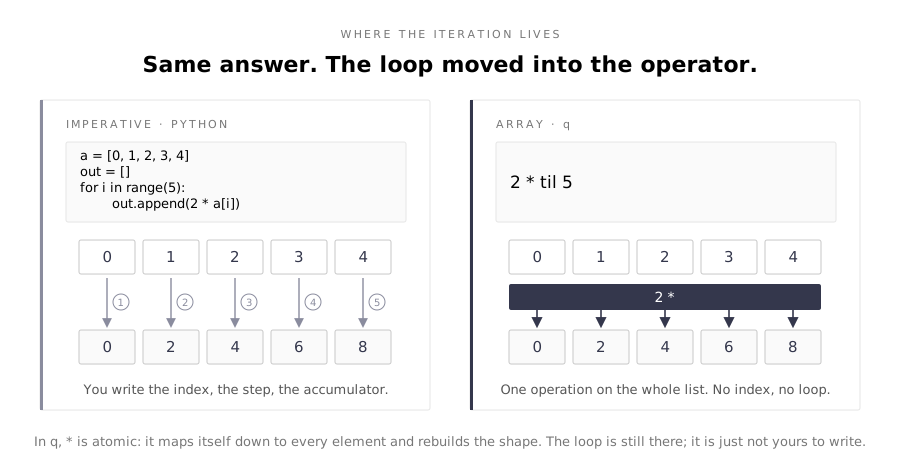
The iteration didn’t disappear; it moved into the operator. Every idea in this curriculum is that move, applied to something bigger: a table, a query, a join.
The thesis
Most “learn an array language” material teaches syntax. Syntax is not the hard part. The hard part is unlearning the loop, and the reason that is hard is that nothing forces it.
You can write q for months with do[], while[], an index variable and an accumulator. It works.
The answers are correct. There is no error and no warning;
nothing in the language pushes back. A language comfortable enough to let you stay imperative will not teach you to stop being
imperative.
So: J as a short laboratory, then q as the destination. J is where the shift is unavoidable: its ordinary notation gives you nowhere comfortable to put a loop. q is where you ship. J is one or two read-along lessons; you need no J toolchain to read the repo. Everything after the transition chapter is q: real tables, qSQL, attributes, an as-of join.
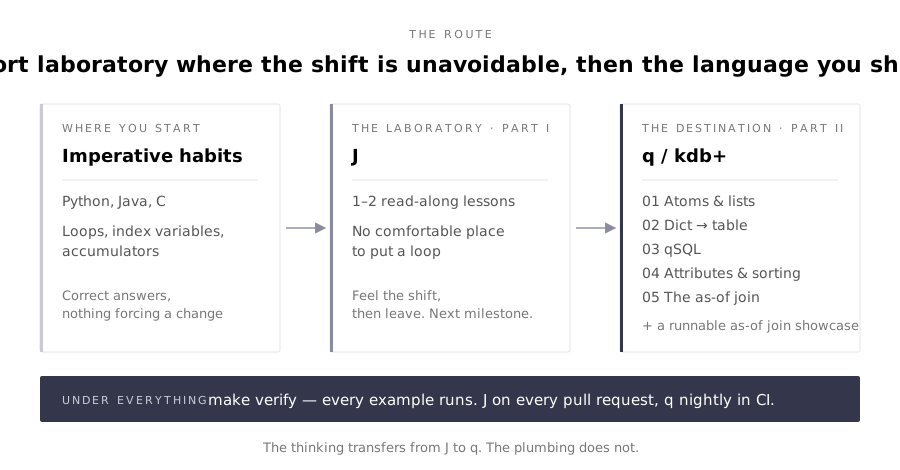
I should be honest that J is the laboratory partly for an unglamorous reason: it is the array language I already think in, so that half costs hours instead of weeks. If you have no destination in mind and just want the paradigm, BQN is probably a gentler on-ramp. The concepts transfer either way.
Why there is a hierarchy of objectives, and what it bought
The project has four objectives, ordered, with a standing rule that when they conflict, the lower-numbered one wins:
- Learning. I write real running q, and learn skill evaluation as a transferable discipline.
- Curriculum. Verified lessons: imperative programmer → array-native.
- Skill evaluation. An independent, published evaluation (authoring something only if that evaluation proves a gap).
- Blog. Five articles as a forcing function. Exhaust of the work, never its driver.
That looked like planning ceremony when I wrote it. Then it did real work, twice.
Once, when the ground moved. Objective 3 originally read “author a q skill for Claude Code.” Partway through setup I discovered KX already ships a family of official Claude Code plugins, covering q, PyKX, KDB-X and KDB.AI among others, with their own marketplace and a linter integration. Authoring a competing general-purpose q skill would be redundant.
Without a hierarchy that is a small identity crisis. With one it is a lookup: the learning objective says “authoring and evaluation”, and evaluation survives the discovery completely intact. So the deliverable changed from a skill to an independent evaluation of the one that already exists, and authoring got gated behind that evaluation finding a gap. Ten minutes, not a week of sulking.
Once, when it would have been convenient to forget it. Objective 4 says the blog is exhaust, never the driver. That is easy to agree with and hard to honour, because “what would make a better article” is a genuinely seductive input. It has already forced a null result into the open (the evaluation is published in the repo; article 2 writes it up) and thrown away the framing I wanted for another (article 3). Both were correct calls and neither was comfortable.
The constraint the whole repo is built around
Everything executes. A q or J example does not land in a lesson unless make verify runs it.
Printed outputs are captured from the real interpreters and pasted in, never hand-typed, never
reconstructed from memory.
Exactly two blocks are exempt, both marked where they appear: an illustrative Python snippet showing the instinct being unlearned, and one q expression that fails to parse on purpose, which therefore cannot live in a verify-clean file and is quoted as a real REPL transcript instead.
The cap of two is deliberate. Exemptions are the kind of thing that go from two to nine without anyone deciding.
That rule sounds like ordinary testing discipline. In a teaching repo it does something stronger, because the output in the prose is the lesson. A lesson whose printed result drifts from what the tool actually prints is not slightly stale, it is teaching something false — with all the authority of a code block.
The half that verification doesn’t cover
Here is the thing I did not expect, and it is the main reason this article exists.
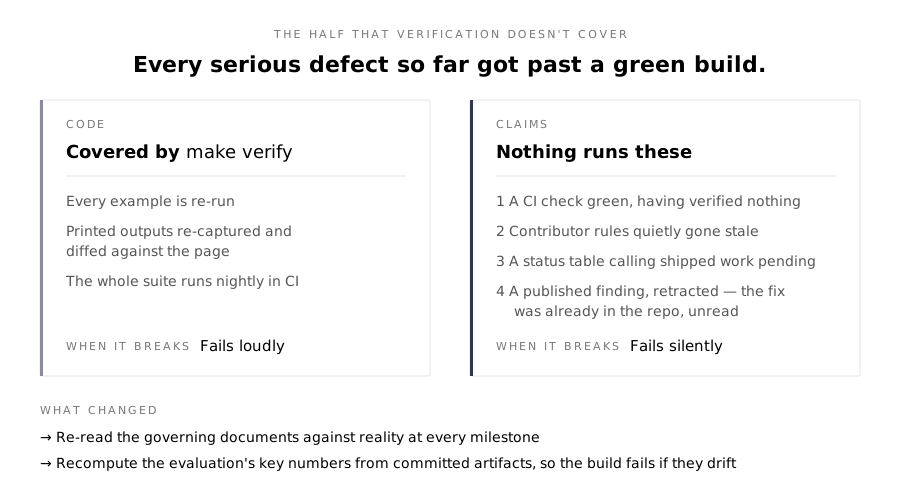
make verify proves my code runs. It says nothing about whether my claims are true. And every
serious defect in this project so far has got past a green build, almost always because what was
wrong was a claim, not a failing line of code.
Four, in order of discovery:
- A CI check that went green having verified nothing. Its install step was a commented TODO gated on “when the first J file lands”; the files landed, the gate was never updated, and the tick stayed green. A TODO in CI is a time bomb with no alarm.
- Two rules in my own contributor instructions that were accurate when written and had since become false: one pointing at a directory convention that never existed, one holding a decision “pending research” that had concluded weeks earlier. Both read as current.
- A README status table advertising work as pending that had already shipped. I fixed that one in late July, while drafting this article, and when I re-read it two months later, it had gone stale again in exactly the same way.
- And then the one that actually stung, also in late July.
I published an evaluation that came back null, and the one genuinely interesting paragraph in it reported that both test conditions had used the “wrong” attribute on a kdb+ as-of join, against KX’s own documentation. It was the single result with any teeth in an otherwise flat writeup.
It was wrong. The sibling page of the same reference says the attribute they chose is legitimate under exactly the conditions present. Worse: my own repository had already recorded that correction, in writing, three days earlier, in an audit I ran and then never re-read. I cited one page, drew the opposite conclusion, and shipped it.
Two things I took from that. First, the claim that flatters your thesis is the one to attack hardest: it is precisely the one that gets the least scrutiny, because you want it to be true. Second, prior work does not protect you if nothing routes you back to it. A verified finding filed in a document nobody re-reads is indistinguishable from a finding never made.
It has happened again since. In September an independent review of lesson 05 found a sentence
calling a loop “order-proof” that was true on every input the lesson used and false on one it
didn’t: two quotes at the same timestamp. make verify was green throughout: it proves the outputs
on the page are real, not that a sentence with “always” in it generalises. That one has its own
story in article 3.
So the repo now has a mandatory per-milestone step to re-read its own governing documents against
reality, and part of the published evaluation has a make target that recomputes it from committed
artifacts and fails if the committed table disagrees (specifically the pass/fail column and the
per-session activation traces, which are the numbers a reader is most likely to take on trust). The
judgement-based scores it cannot recompute, so those stay defended by writing the scoring rules down
before scoring. Both exist because of specific defects, not because they sounded rigorous. And
since late July a nightly CI job runs all of make verify against a licensed q, so none of this
depends on my machine or my memory.
What publishing the misses actually costs
It is not “post progress.” Progress posts are easy and roughly worthless.
It means the null result gets published with the same effort as a positive one would have. It means when the interesting paragraph turns out to be wrong, you go back and retract it in the evaluation that already shipped, which I have now done, and which is a strange feeling I recommend. It means the repository carries the raw material behind every number: all fifty session logs from that evaluation, the exact prompts, the scoring rationale, the losing answers.
And it means writing down the mistakes in enough detail that they are useful to someone else, which is harder than it sounds, because the useful part is usually the reasoning that led you astray rather than the wrong answer itself.
The upside is straightforward: I am a better q programmer than when I started, and I now have an evaluation harness I trust — mostly because it has already caught me.
The five articles
- This one: the project, the rules, and what they cost.
- No headroom: what a null result on KX’s q plugin actually measured: a controlled evaluation, a null result, and why the null is about my benchmark rather than their plugin.
- The as-of join: what changes when the language and the storage engine are designed around one primitive. No benchmark numbers; the article explains why.
- Unlearn the loop: what J shows that q hides: the laboratory, and the two places it lies to you on the way home.
- What compounds: packaging the lessons-learned file that gets appended at every milestone.
Articles 2–4 are drafted; 5 is packaging. Each publishes only when the artifacts it describes actually verify, which is the same rule as the code, applied to the writing.
Not affiliated with, sponsored by, or endorsed by KX Systems, Inc. or Jsoftware, Inc. “q”, “kdb+”, “KDB-X” and “J” are third-party marks used nominatively.